



Burst Mode Bit Error Ratio Tester
rBT3250
50G Burst Mode Bit Error Ratio Tester
Semight 50G Burst Mode Bit Error Ratio Tester rBT3250 is specifically designed for testing new burst error code analyzers for optical line terminals (OLTs) in next-generation 25G/50G passive optical network (PON) applications, used to evaluate the performance of 25G or 50G OLT receivers in burst mode.
Features

Multirate
GPON: 12.4416/
Excellent Performance
Supports burst and continuous mode data signal output and error bits testing
Control Signal Matching
Provides 2 synchronous enable control signals for ONU laser: LVTTL 3.3V, configurable enable level
Rich Trigger Signal
Supports 1 RSSI Trigger signal: trigger mode, adjustable cycle, position, and pulse width
High Efficiency
Quick configuration download and fast hardware response speed
Fully Match ATE Application
With powerful and flexible database management capabilitiesFunctions and Advantages

Burst Mode
Burst Mode supports 24.8832/25.78125 GBaud PAM4 testing.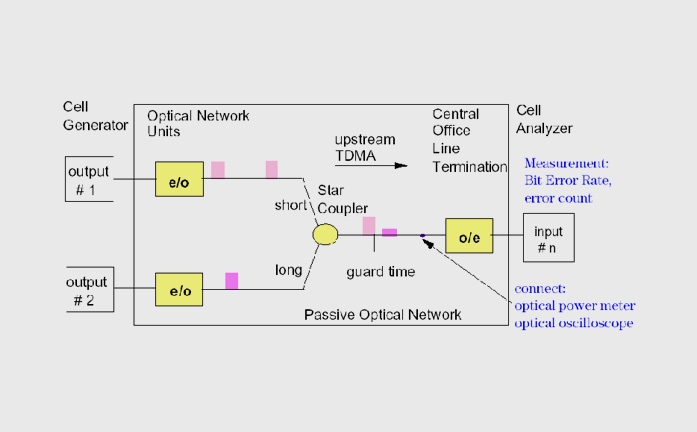
Dual Package Testing
Each data packet has different attenuation, there is a phase jump between different data packets, and there are long connections of "1" and "0" in the data packets.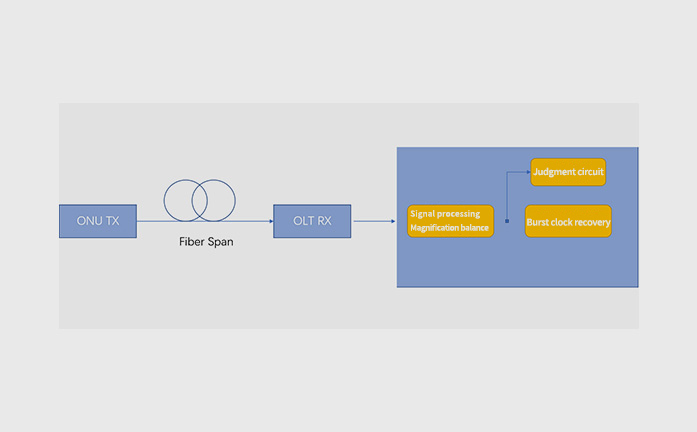
Built-in Clock Recovery, Supports for Long Fiber Testing
The built-in clock recovery allows rBT3250 to operate in a real long fiber working environment, which is basically impossible to achieve in other commonly used solutions in the industry, because those systems do not support clock recovery and cannot adapt to the impact of long fibers on latency and jitter.|
Type |
Item |
Description |
|
Pattern Generator Specification |
Output |
Differential NRZ/PAM4 |
|
Terminal |
AC Coupling |
|
|
Output Impedance |
100 Ω ± 10% |
|
|
Pattern |
PRBS7, 15, 23, 31, SSPR, Custom Defined Pattern and CID |
|
|
Burst Signal Rate (GBaud)[1] |
NRZ: 12.4416/24.883/25.78125/49.7664/51.5625 |
|
|
Frequency Accuracy |
±50 ppm (typical) |
|
|
Output Amplitude (differential) |
100-900 mVp-p (typical) [1] |
|
|
Rise Time [2] (20–80%) |
<12 ps (typical) |
|
|
Fall Time [2] (20–80%) |
<12 ps (typical) |
|
|
Random Jitter [3] |
<1.2 ps (typical) |
|
|
Laser Enable(TXEN) |
LVTTL 3.3V |
|
|
Reset Signal |
LVTTL 3.3V, adjustable voltage level, trigger position, and width |
|
|
Connector |
2.4mm female, 50 Ω |
|
|
|
Clock Output Amplitude |
>200 mVp-p |
|
Output Type |
AC Coupled, Single-ended |
|
|
Div Ratio (Adjustable) |
4/8/16 |
[1] 9.953/10.3125 GBaud awaiting supportr
[2] Measured with 49.7664 GBaud NRZ
[3] Tested with/after Jitter separation
|
Type |
Item |
Description |
|
Error Detector Specification |
Input |
Differential NRZ |
|
Terminal |
AC Coupled |
|
|
Input Impedance |
100 Ω ±10% |
|
|
Input Range (Differential) [1] |
100 ~ 900 mVp-p (typical) |
|
|
RSSI (Differential) [2] |
100 mVp-p (typical) |
|
|
Pattern |
PRBS7, 15, 23, 31, CID |
|
|
Burst Signal Rate (GBaud) |
NRZ: 12.4416/24.883/25.78125/49.7664/51.5625 |
|
|
Connector |
2.4mm female, 50 Ω |
[1] Take care of output amplitude from DUT as the high voltage signal may damage the receiver
[2] If the input is below the sensitivity threshold, high bit errors or LOS may occur
Similar recommendation

High speed communication test plays an important role in the rapid development of big data, cloud computing, 5G communication and other markets.
Semight offers various of instruments for optical Transceiver/Component testing, including wide bandwidth sampling oscilloscope, NRZ/PAM4 bit error ratio tester , burst error ratio tester, fast wavelength meter, high precise source measure unit, 400G network analyzer ,optical power meter, optical attenuator, optical switch etc. We provide cost-effective, complete solutions for optical testing.

The high-precision source measure units integrates the functions of voltage source, current source, voltmeter, ampere meter, and electronic load in one, which is widely used in high-precision IV test and measurement for various discrete components, photovoltaic, green energy, battery and other industries. Semight provides high-precision benchtop SMU and plug-in PXIe SMU of standard PXIe chassis, fully meeting the application of various test scenarios.
Details
Burn-in testing of laser is an important method to ensure the reliability of laser. Through the test of CoC or bare die, the early failure of laser caused by the defects in the process of laser production can be screened out in advance. Semight provides a complete solution from bare die to CoC, from high temperature(150℃ or higher) to low temperature (-40℃), with CoC automatic loading and unloading system, forming a complete test solution, Semight's laser chip burn-in/load/unload test system has been widely recognized by the market.
Details
The semiconductor front-end test is mainly used in the wafer processing to check whether the processing parameters of the wafer products meet the design requirements or there are defects affecting the yield after each step of the manufacturing process. The semiconductor back-end test equipment is mainly used after wafer processing to check whether the performance of the chip meets the requirements, which belongs to the electrical performance test. Semight provides solutions such as Wafer Level Burn In system and Known Good Die handler for SiC testing, offering the value to customer in test efficiency improvement and test cost reduction.
DetailsFollow
Name
E-mail verfication code
Phone
Password
Confirm Password
E-mail address
E-mail verification code
New Password
Confirm Password

 Datasheet
 Ask for demo