



High Speed Transceiver ATE
MTP8104
800G Quad-Port Optical Transceiver Tester
Semight MTP8104 is a comprehensive Bit Error Rate Analysis system which integrates multi-channel Bit Error Rate Tester, multi-port MCBs to host optical transceiver, and multi-channel independent temperature control units, making it ideal for mass-produced testing of high-speed 400G/800G optical transceiver across various ambient thermal cycle settings.
Features

Flexible Application
Wide Data Rate Range: 24.33~56.4 GBaud
Comprehensive Capabilities
Supports PCS hardware layer's FEC error correction analyzer
Excellent Signal Quality
Rapid rise and fall time, low intrinsic jitter
Rich Test Patterns
PRBS7~31Q; SSPRQ /JP03A /JP03B /LIN /Square wave/Custom defined patterns, etc.
High Efficiency
Low cost and high efficient three-temperature cycling solution with TEC
Rich Accessories
Low maintenance costs like easy-replaceable MCBs
Cost-effective
Convenient configuration & replacement of accessories, which significantly reduces the overall testing cost
Fully Match ATE Application Scenarios
With powerful and flexible database management capabilities, it aids in the in-depth analysis of data for research and development purposesFunctions and Advantages
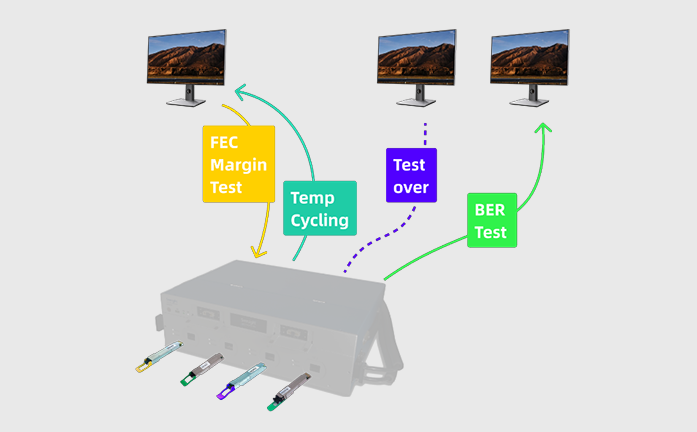
Multi-host Parallel Travel Control, More Flexible ATE Multi-threaded Task Processing
It supports mixed parallel testing of different types of modules, and supports testing OSFP/QSFP-DD/QSFP112/QSFP56 modules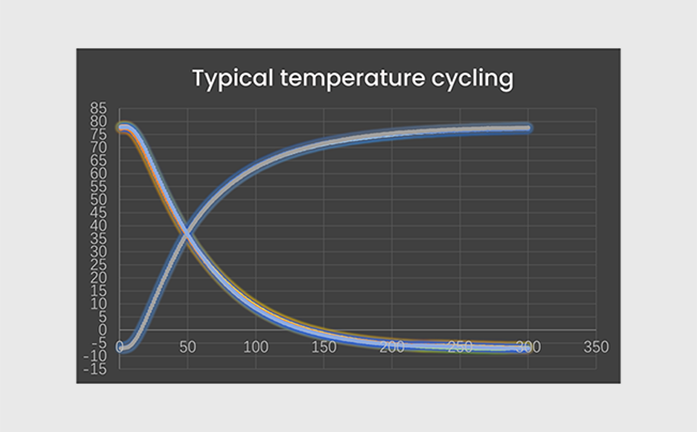
Scientific Design: Double-sided TEC+ Water Cooler to Achieve Stronger Temperature Circulation Efficiency
Ramp time: ~2 min
Integrated Optical Port Error Analyzer (BERT), MCB, and TEC Temperature Cycle Control Unit
It can be applied to the bit error performance and eye diagram quality test of 400G/800G optical modules in high and low temperature environments.
Easy to Use & High Cost-Effectiveness
Status monitoring of TEC, MCB connector, and crimping box|
800G Test Solution |
||
|
Model |
DUT |
Quantity |
|
MTP8104 |
400G/800G OSFP |
4 |
|
400G/800G QSFP-DD |
4 |
|
TX Specification
|
Type |
Item |
Description |
|
Pattern Generator Specification |
Output |
Differential PAM4/NRZ |
|
Quantity of DUT in Parallel |
4 |
|
|
Terminal |
AC Coupling |
|
|
Output Impedance |
100 Ω ± 10% |
|
|
Pattern |
PRBS 7/9/11/13/15/23/31. PRBS7~31Q SSPRQ, JP03A, JP03B, LIN, Square wave, Custom Defined pattern, etc. |
|
|
Symbol Data Rate [1] (GBaud) |
24.33/24.8832/25/25.78125/26.5625/27.89/27.95/28.05/28.125 |
|
|
Frequency |
±50 ppm (typical) |
|
|
Output Amplitude (Differential) |
750 mVp-p (typical) [2] |
|
|
Rise Time [3] (20–80%) |
<10 ps (typical) |
|
|
Fall Time [3] (20–80%) |
<10 ps (typical) |
|
|
Random Jitter [4] |
<350 fs (typical) |
|
|
|
Clock Output Amplitude |
>300 mVp-p |
|
Output Type |
AC Coupled, Single-ended |
|
|
Div Ratio (Adjustable) |
4/8/16/32 |
|
|
Trigger Output |
Support independent clock output for each port |
[1] Option can be added to support expansion the rates <48G.
[2] Net measurement value at the transmitter’s end, default pre-emphasis/de-emphasis parameters.
[3] Tested with 53.125 Gbps NRZ signal.
[4] Tested with/after Jitter separation.
RX Specification
|
Type |
Item |
Description |
|
Error Detector Specification |
Input |
Differential PAM4 /NRZ |
|
Terminal |
AC Coupled |
|
|
Input Impedance |
100 Ω ±10% |
|
|
Input Range (Differential) [1] |
150 ~ 750 mVp-p (typical) |
|
|
RSSI (Differential) [1] |
150 mVp-p (typical) |
|
|
Pattern |
PRBS 7/9/11/13/15/23/31, PRBS7~31Q, SSPRQ |
|
|
Symbol Rate (Gbaud) [2] |
24.33/24.8832/25/25.78125/26.5625/27.89/27.95/28.05/28.125 |
|
|
Clock Mode |
Built-in Clock Recovery |
|
|
Sync |
Auto Sync (Level/Phase) |
[1] Excessively high output amplitude of the device under test may damage the receiver.
[2] Option can be added to support expansion the rates <48G.
Optical Transceiver Testing Specification
|
Type |
Item |
Description |
|
TC Specification [1][2] |
TC Mode |
Contact TEC temperature control |
|
TC Range |
-5 ~+85 ℃ [3] |
|
|
Stability |
±1 ℃ [4] |
|
|
Accuracy |
±0.1 ℃ |
|
|
Vcc Bias Tuner |
BIAS Range |
2.85~3.67 V |
|
Step |
1 mV[5] |
[1]The TC efficiency might fluctuate due to factors such as the ambient temperature, the power consumption of various transceivers, the location of heat sources, and the output power of the chiller
[2]Due to condensation by long-term low temperature use, the inner space should be circulated with dry and clean air, and periodically heated for drying
[3]Test environment: Room temperature of 25℃, 15W module placed in a closed space to reduce heat exchange with outside; Feedbacked by DMI temperature
[4]Perform repeat measurements of the temperature difference between the set temperature and case temperature
[5] Measured in the Semight Laboratory test environment (constant temperature 25°C, constant load 12W)
Similar recommendation

High speed communication test plays an important role in the rapid development of big data, cloud computing, 5G communication and other markets.
Semight offers various of instruments for optical Transceiver/Component testing, including wide bandwidth sampling oscilloscope, NRZ/PAM4 bit error ratio tester , burst error ratio tester, fast wavelength meter, high precise source measure unit, 400G network analyzer ,optical power meter, optical attenuator, optical switch etc. We provide cost-effective, complete solutions for optical testing.

The high-precision source measure units integrates the functions of voltage source, current source, voltmeter, ampere meter, and electronic load in one, which is widely used in high-precision IV test and measurement for various discrete components, photovoltaic, green energy, battery and other industries. Semight provides high-precision benchtop SMU and plug-in PXIe SMU of standard PXIe chassis, fully meeting the application of various test scenarios.
Details
Burn-in testing of laser is an important method to ensure the reliability of laser. Through the test of CoC or bare die, the early failure of laser caused by the defects in the process of laser production can be screened out in advance. Semight provides a complete solution from bare die to CoC, from high temperature(150℃ or higher) to low temperature (-40℃), with CoC automatic loading and unloading system, forming a complete test solution, Semight's laser chip burn-in/load/unload test system has been widely recognized by the market.
Details
The semiconductor front-end test is mainly used in the wafer processing to check whether the processing parameters of the wafer products meet the design requirements or there are defects affecting the yield after each step of the manufacturing process. The semiconductor back-end test equipment is mainly used after wafer processing to check whether the performance of the chip meets the requirements, which belongs to the electrical performance test. Semight provides solutions such as Wafer Level Burn In system and Known Good Die handler for SiC testing, offering the value to customer in test efficiency improvement and test cost reduction.
DetailsFollow
Name
E-mail verfication code
Phone
Password
Confirm Password
E-mail address
E-mail verification code
New Password
Confirm Password

 Datasheet
 Ask for demo